Our Next Steps: Connecting Upcoming Graduates With Community Members to Practice and Prepare for Their Next Journey

Wesource incoming! In this post, I have attached a language intervention I developed for my Language, Education, and Diversity class with Dr. Emily Phillips Galloway. My inspiration for this intervention stemmed from my own experiences applying to college in a rural community with limited resources to aid in my application process.

I hope this wesource can serve as an inspiration for your own context! Please don’t hesitate to comment or reach out with comments or questions. I would love to hear your feedback!

The Writing Process – Anne Haughton

I am very happy to share that Anne Haughton has shared our first Wesource with us – The Writing Process!

From Anne: “The Writing Process (Google Slides presentation) was created as a general resource for teaching the writing process to elementary-level students. Could be used & adapted in many different contexts!”

The following link allows anyone the option to edit the presentation in Google Slides themselves or download it as a PDF: https://docs.google.com/presentation/d/1NjVAhGbpD10guVbkJPd6SgHRl3ocLDFzr-4UXvEKrNA/copy

Thank you, Anne!

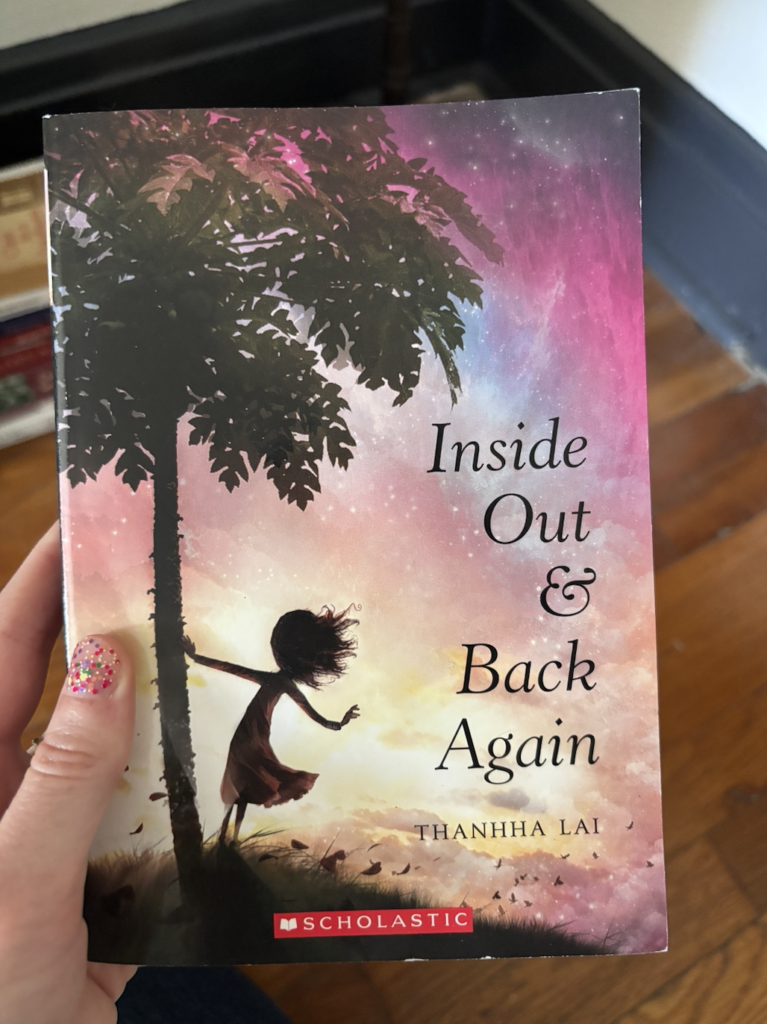
“Inside Out and Back Again” by Thanhha Lai

Rating: ★★★★★/5

One Word to Describe It: Wow!

This book was such an enjoyable read – I literally couldn’t put it down until it was finished. I’d heard lots of discourse around it, particularly in my education classes this past semester, and went ahead and bought a copy for myself. As an Alabama girl, the novel’s setting drew me in as the plot explores Hà and her mother and brothers’ encounters in Alabama after emigrating from Saigon.

I can see students especially finding connections in this novel’s many characters. Hà interacts with multiple people throughout this novel (TiTi, Miss Xinh, MiSSSisss WaSShington, and Pink Boy, to name a few) while still being grounded in daily interactions with her mother and three brothers. Because we get so much interaction with other characters, albeit through Hà’s perspective, students aren’t limited to connecting with her alone – they might see a friend’s passion for yummy food and cooking in Vu Lee or a love for all of language’s “annoyances and illogical rules. as well as sensible beauty” like MiSSSisss WaSShington. I also think this would be such an ideal novel if you teach in Alabama or one of its surrounding states! I’m really happy I decided to read this, and I imagine teaching this novel would be a blast.

Some poems that stuck with me (mainly because of commentary on language):

Black and White and Yellow and Red

Feel Dumb

New Word a Day

Spelling Rules

Start Over

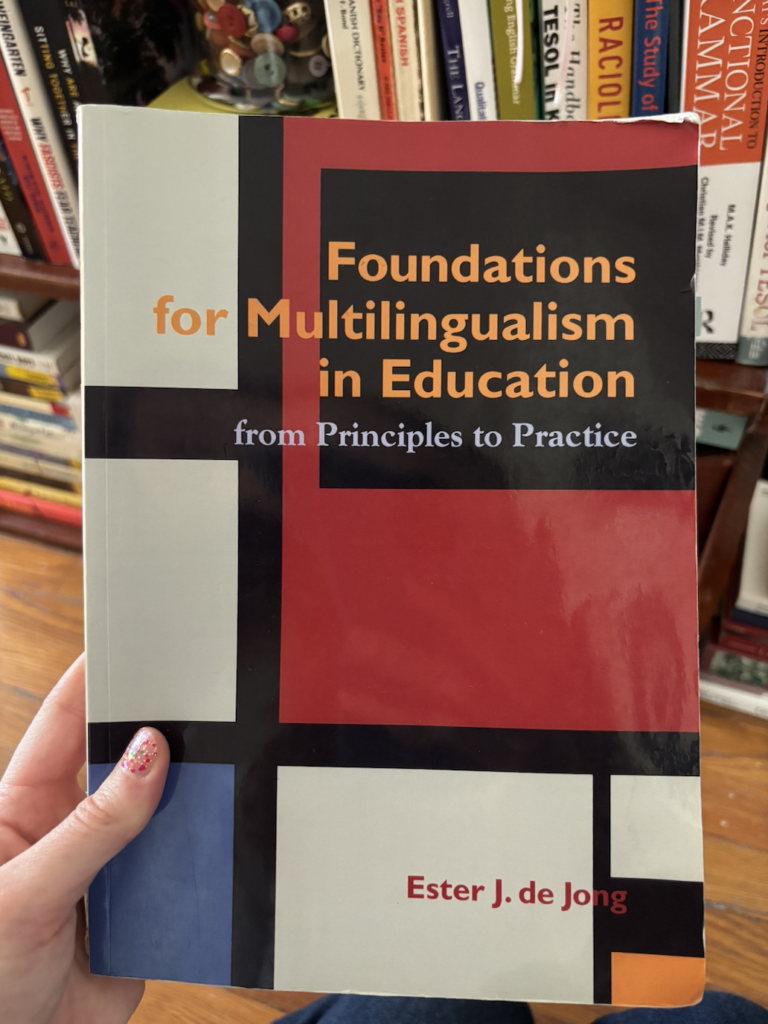
“Foundations for Multilingualism in Education: From Principles to Practice” by Ester de Jong

Rating: ★★★★/5

One Word to Describe It: Foundational (no pun intended)

This book was one of the base texts for a course I took last semester, Foundations of Multilingual Education, with Dr. Shannon Daniel. Pulled from our syllabus, this course covered all of the “historical, political, legal, theoretical, cultural, and educational influences that shape schooling for multilingual students learning English as an additional language.” While this book is a little outdated (published in 2011), it felt wholly relevant. In our current academic publishing scene of citing what feels like every thought you have, I found the lack of citations in every other sentence quite refreshing.

My main takeaway was de Jong’s four principles for multilingual education: a) educational equity, b) affirming identities, c) promoting additive bi/multilingualism, and d) structuring for integration. Also, as someone who has found a recent interest in policy, I appreciated the time she took in Chapter 6 to walk through how language policy in the United States has shifted over the past century. Very pleasant read – I recommend!

What is a wesource?

A wesource, my play on an alliteration in this blog’s name, is an open access resource for and from all of us. While I love a good Teachers Pay Teachers, I also quite like accessible resources teachers don’t have to scrounge up money for. It is my hope that this page will, overtime, begin to flourish as a hub if you find yourself wishing to pull a downloadable material, lesson plan, or browse our resources to inspire you. Feel free to fill out this form for consideration:

https://docs.google.com/forms/d/e/1FAIpQLSeIrvADZ9obfBYuU28L4-ZrTk7yfGYNbZ5dWHHxskUmINDcvQ/viewform?usp=publish-editor

Introductions & Ellaborations

Hello, all! I am so excited you’ve stumbled across my corner of the internet. My name is Savanah Stewart, and I am currently a graduate student studying Multilingual Learner Education. While I’ve wanted to start a blog for my previous, current, and future work with multilingual learners, an upcoming assignment in my Language, Education, and Diversity class has given me the push to finally materialize this idea into a working website.

Its name, Wugerful Wesources, was inspired by my love for all things to do with Jean Berko Gleason’s iconic wug test in the 1950s. The whole title is a play on the idea of having wonderful resources but with a sprinkle of linguistic flair.

As I continue graduate school, I’ll primarily be posting from the “scholarly” side of multilingual education (aka I don’t have my own classroom just yet). However, when I graduate in May 2027, I so look forward to sharing more of my practical experiences and materials with all of you once I become an ESOL teacher in the Southeast.

Here’s to the beginning of our wugerful journey on this platform!